Imagine standing on a vacant lot in Massapequa or looking at your existing backyard in Wantagh, feeling the brisk salt air rolling in from the Great South Bay. You have a vision of a home that doesn’t just house your family but actually enhances your lifestyle—a space designed for the hybrid work realities of 2026, equipped with high-efficiency systems that laugh at Long Island’s humid summers and erratic winters. However, between you and that finished masterpiece lies a labyrinth of Town of Hempstead building codes, complex soil drainage requirements, and the daunting task of finding a team that treats your property like their own.
In 2026, the Long Island residential landscape has shifted. We are no longer just building boxes; we are engineering environments. As leading custom home builders, Praiano Home Improvement understands that a home in Nassau or Suffolk County must be a fortress of comfort and a marvel of modern efficiency. Whether you are looking to scrap an old structure for a fresh start or execute a massive structural expansion, the process requires a partner who knows the local soil as well as they know the local zoning boards.
The 2026 Long Island Housing Shift: Why Customization is the New Standard
The real estate market on the Island has reached a unique inflection point this year. Inventory for “move-in ready” luxury homes is at a historic low, while the desire for specific, tech-integrated living spaces is at an all-time high. This has led many families to realize that the only way to get exactly what they need—from integrated EV charging hubs to soundproofed multi-generational suites—is to build it from the ground up or undergo a total structural reimagining.
The Rise of the Multi-Functional Estate
In 2026, a house is no longer just a place to sleep. It is a corporate headquarters, a private wellness center, and a multi-generational sanctuary. We are seeing a massive trend toward “Flex-Wing” architecture. These are spaces that can transition from a professional video-conferencing studio during the day into a comfortable guest suite by night. As Wantagh home improvement specialists, we’ve adapted our building techniques to include hospital-grade air filtration and acoustic dampening as standard features, not luxury add-ons.
Environmental Resilience in Coastal Zones
Building in Long Island NY requires a deep respect for the Atlantic. Our 2026 projects prioritize “Hardened Shell” construction. This means utilizing materials that resist salt-air corrosion and wind speeds that would rattle a standard build. When we talk about custom building today, we are talking about creating a structure that will remain rock-solid for the next fifty years, regardless of what the North Atlantic throws our way.
Navigating the Local Regulatory Landscape: The Praiano Advantage
One of the biggest hurdles in any custom build or major addition is the bureaucratic maze of Long Island’s various townships. From the strict height restrictions in the Village of Garden City to the complex setbacks in the Town of Oyster Bay, your project can live or die in the permit office.
The “Zoning Interpreter” Role
Think of a town’s building code like a complex foreign language. If you try to translate it literally, you’ll run into trouble. We act as your interpreters. Because we have spent years working with local inspectors and zoning boards, we know the “why” behind the rules. This allows us to design your custom home or home addition in a way that sails through the approval process rather than getting stuck in a cycle of revisions.
Addressing the “NIMBY” Factor
In many established Long Island neighborhoods, neighbors can be protective of the local aesthetic. A custom builder must be a diplomat. We focus on “contextual customization”—creating a home that is undeniably modern and high-performing on the inside, while respecting the architectural soul of the surrounding neighborhood on the outside. This ensures a smoother project and better relationships with your new neighbors from day one.
Advanced Building Science: The Anatomy of a 2026 Custom Build
To the untrained eye, a house is just wood, stone, and glass. But as professional custom home builders, we see a complex series of interconnected systems. If one system fails, the whole “organism” suffers.
The “Gore-Tex” Analogy for Home Envelopes
Think of your home’s exterior like a high-performance jacket you’d wear for a hike in the rain. You want it to be waterproof so the rain doesn’t get in, but you also want it to be breathable so you don’t get soaked from your own sweat. In 2026, we use “Intelligent Vapor Barriers.” These advanced membranes prevent Long Island’s driving rain from penetrating the walls, but they allow internal humidity—from cooking, showering, and breathing—to escape. This prevents the “hidden rot” that destroyed many homes built in the 1990s.
Comparing Modern Foundation Technologies
| Technology | Traditional Poured Concrete | Insulated Concrete Forms (ICF) |
| Energy Efficiency | Low; requires interior insulation | Extreme; built-in double-layered insulation |
| Moisture Resistance | Prone to hairline cracks over time | Seamless barrier; acts like a “bathtub” seal |
| Acoustic Rating | Standard | High; blocks street and plane noise |
| 2026 Demand | Moderate | High (Preferred for South Shore builds) |
The Lifecycle of a Custom Project: From Soil to Sovereignty
The journey of building a custom home is often portrayed as a stressful marathon. At Praiano Home Improvement, we’ve refined the workflow into a transparent, phase-based evolution that keeps the homeowner in control without the headache.
Phase 1: The Site Feasibility and Soil Analysis
Long Island soil is notoriously varied. You might have sandy, fast-draining soil in one town and heavy, water-trapping clay just three miles away. Before we pour a drop of concrete, we perform a “Perc Test.” Think of this like checking the drainage of a coffee filter; if the water doesn’t move through at the right speed, we have to engineer a specialized drainage system (like a dry well) to ensure your basement stays dry even during a 2026 Nor’easter.
Phase 2: Architectural “Logic” Mapping
During the design phase, we don’t just ask where you want the kitchen; we ask how you use your morning. We map the “flow” of your daily life. Do you need a “Mudroom Transition Zone” to catch the sand from the beach? Do you need a “Delivery Portal” for secure package drops in an era of constant e-commerce? This is the “Custom” in custom building.
Phase 3: The Mechanical “Nervous System”
This is the part you never see, but you’ll feel every day. In 2026, we utilize “Zoned Comfort Technology.” Instead of one giant, loud air conditioner, we install multiple smaller, whisper-quiet “heart” units. This allows you to keep the master suite at 68 degrees while the guest wing stays at 72, saving an immense amount of energy and investment over the life of the home.
The Evolution of the Long Island Home Addition
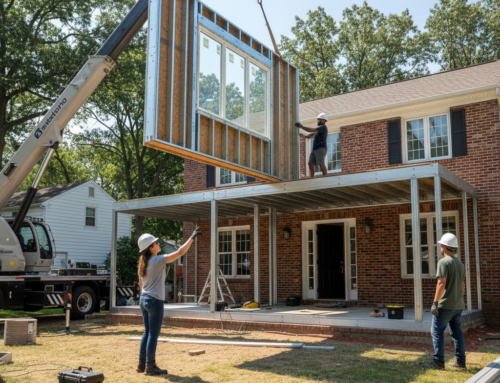
Sometimes, a custom home isn’t a new build; it’s a total reimagining of an existing structure. On Long Island, many of our clients love their neighborhood but have outgrown their 1950s-era Cape or Colonial. This is where the artistry of home additions meets custom building.
Seamless Structural Integration
The hallmark of a “Praiano Addition” is that you can’t tell it’s an addition. We don’t just “bolt on” a new room. We perform a “structural handshake” between the old house and the new section. This involves matching roof pitches, sourcing matching brick or siding from specialized 2026 vendors, and ensuring the new foundation is tied into the old one so they settle together at the same rate.
Vertical Expansion: The “Pop-Top”
In areas like Wantagh, where lot sizes might be limited, the only way to go is up. A vertical expansion is like adding a second story to a skyscraper. It requires a meticulous check of the “load-bearing” capacity of your first-floor walls and foundation. If the “legs” aren’t strong enough, we reinforce them with hidden steel “spines” before adding the new level.
Material Selection in 2026: Balancing Luxury with Longevity
In the 2026 building market, we have access to materials that were science fiction just a decade ago. We help our clients navigate these choices, focusing on “Total Value” rather than just the initial investment.
Smart Glass and Thermal Management
Windows are the “eyes” of the home, but they are also the biggest source of energy loss. We now install “Electrochromic Glass.” Think of this like transition lenses for your house. When the July sun is beating down on your South Shore home, the glass automatically tints to block the heat while keeping your view crystal clear. This reduces the strain on your AC system and prevents your furniture from fading.
Composite Siding vs. Natural Cedar
While the classic Long Island look often involves cedar shingles, the maintenance can be a nightmare in our salty, humid air. We frequently guide our clients toward “Polymer-Fiber Composites.” These materials are molded from real cedar shakes but are essentially “immortal.” They don’t rot, they don’t peel, and they don’t require painting every five years. It’s the “Set it and Forget it” philosophy of 2026 homeownership.
The Psychological Impact of Custom Design
We often talk about the “ROI” (Return on Investment) in terms of dollars, but as custom home builders, we also focus on the “ROH” (Return on Happiness). A home that is custom-built for you reduces the “micro-frictions” of daily life.
- The Acoustic Sanctuary: By using staggered-stud framing and specialized “Quiet-Rock” drywall, we can ensure that your home office is a tomb of silence, even if your kids are watching a movie in the next room.
- The Circadian Lighting System: Our 2026 custom homes feature lighting that shifts color temperature throughout the day—mimicking the sun’s natural rhythm. This helps regulate your sleep-wake cycle, making you feel more energized in the morning and more relaxed at night.
- The “Sand-Trap” Mudroom: For our coastal clients, we design custom entryways with integrated foot-washes and slatted drainage floors. No more sand tracked across the hardwood.
Why “Local” is a Technical Requirement, Not Just a Buzzword
You might see “national” home builders advertising on Long Island, but building here is a different animal than building in the Midwest or the South.
Adapting to Long Island’s “Micro-Climates”
The weather in Montauk is not the weather in Long Beach, and the soil in Huntington is not the soil in Levittown. A local builder understands these nuances. We know that on the North Shore, we have to deal with “glacial till” (large rocks and unpredictable soil) that can complicate a foundation. On the South Shore, we have to account for higher water tables and flood-zone elevations.
The Power of Local Trades
When you hire Praiano Home Improvement, you are tapping into a network of Long Island’s best plumbers, electricians, and HVAC technicians. These are professionals who live in Wantagh and surrounding towns. They aren’t going to cut corners because they know they’ll see you at the local deli or the beach. This accountability is the “hidden ingredient” in a high-quality custom build.
Sustainable Luxury: Building for 2026 and Beyond
In 2026, “Green Building” is no longer an optional “extra”—it is the smartest way to build. We focus on “Passive House” principles, which act like a high-end thermos for your life.
The “Thermos” Effect
If you put hot coffee in a cheap plastic cup, it’s cold in ten minutes. If you put it in a high-end vacuum-sealed thermos, it stays hot all day. We build homes that act like that thermos. By creating an airtight seal and using massive amounts of high-performance insulation, we create a home that barely needs a heater in the winter or an AC in the summer. This isn’t just about saving the planet; it’s about the “Value-Based” reality that your monthly utility bills will be a fraction of your neighbors’.
Solar-Ready Infrastructure
Even if you aren’t installing solar panels today, our custom builds are “Solar-Ready.” We pre-wire the house and reinforce the roof structures so that when you are ready to make the jump, the investment is thousands of dollars less because the “skeleton” is already there.
Comparing Construction Strategies for Long Island Homeowners
| Project Type | Best For | Structural Impact | ROI Window |
| New Custom Build | Total creative control; clean slate | Maximum | Long-term (10+ years) |
| Second Story Addition | Doubling space on small lots | Significant | Immediate to Mid-term |
| Kitchen/Living Extension | Modernizing 1950s floor plans | Moderate | Immediate |
| ADU / Guest Suite | Multi-generational living | Moderate | Long-term family value |
The Praiano Promise: Radical Transparency in Custom Building
One of the reasons families choose us as their custom home builders is our commitment to a “No-Surprises” philosophy. In 2026, construction costs and timelines can be volatile. We mitigate this through:
- Fixed-Phase Budgeting: We break the project into clear financial milestones. You know exactly what your investment is covering at every stage.
- Digital Project Portals: You can log in from your phone at any time to see photos of the day’s progress, check the delivery status of your custom cabinets, and message your project manager directly.
- The “Punch-List” Obsession: We aren’t done when the house looks “pretty.” We are done when every door swings perfectly, every outlet is tested, and every paint seam is invisible.
The Future of Your Family Starts with a Single Site Visit
Whether you are looking at a teardown in Syosset or planning a massive home addition in Massapequa, the first step is the same: an honest assessment of what is possible.
In 2026, your home should be your greatest asset, not your greatest source of stress. It should be a place that reflects the unique character of Long Island while embracing the most advanced technology the world has to offer. At Praiano Home Improvement, we don’t just build houses; we build the backdrop for the next chapter of your life.
The sand, the salt, and the soil of Long Island are in our blood. We know how to build here, and we know how to build for you. From the first permit to the final coat of paint, we are your partners in creating a structural legacy.
Would you like to schedule a site feasibility study to see if your current lot can support a second-story expansion, or are you ready to discuss a full custom build from the ground up?
Understanding Long Island Building Trends in 2026
To provide a truly comprehensive look at what it means to build a custom home today, we must look at the “Why” behind the “How.” Long Island has always been a place of transition—from the grand estates of the Roaring Twenties to the suburban boom of the Fifties. Today, we are in the era of the “Resilient Smart-Home.”
The Return to Natural Materials (With a Twist)
While we use high-tech composites for exterior longevity, 2026 interiors are seeing a return to natural stone and reclaimed wood. However, these are now integrated with “Invisible Tech.” Imagine a solid walnut kitchen island that has wireless charging pads built under the wood, so your phone charges just by sitting on the counter. This is the marriage of old-world craftsmanship and new-world capability.
Water Stewardship and Aquifer Protection
On Long Island, our water comes from beneath our feet. Modern custom building now includes “Permeable Hardscaping.” Instead of standard asphalt driveways that send oil and grime into the street, we use specialized pavers that allow rainwater to filter directly back into the ground. It’s a way of building that protects the very environment that makes the Island such a beautiful place to live.
The “Healthy Home” Initiative
Indoor air quality has become a top priority for our 2026 clients. We now install “ERVs” (Energy Recovery Ventilators). Think of this like a set of lungs for your house. It constantly pulls in fresh outdoor air, filters it to remove pollen and pollutants, and exhausts the stale indoor air—all while capturing the heat so you aren’t wasting energy. In a custom Praiano home, the air you breathe is often cleaner than the air outside.
The Multi-Generational Shift
As the population ages, the “In-Law Suite” has evolved into a sophisticated architectural feature. These aren’t basements; they are sun-drenched wings with their own kitchenettes, private decks, and “Universal Design” features that make life easier for everyone, from toddlers to grandparents. By building these into your custom project now, you are creating a home that can adapt to your family’s needs for the next thirty years.
Whether you are just starting to browse Wantagh home improvement ideas or you have a full set of architectural plans ready to go, the key is to choose a builder who understands that a house is not a static object. It is a living, breathing environment that must grow with you.